

Does search engine optimization (SEO) really attract more clients than social media? This is a common question in digital marketing.
While there’s no single, simple answer, SEO is often more effective at bringing in clients who are genuinely interested in making a purchase. Social media is useful for reaching many people and building brand awareness, but SEO helps more with getting qualified leads that can become long-term clients.
Of course, using both SEO and social media is a winning strategy. According to Stéphane Torregrosa, an online marketing expert, it’s important to view web marketing as a whole, where all elements complement each other. However, it’s crucial to understand what each lever brings. Here, let’s see why SEO is generally better for acquiring clients, especially in France where succeeding with SEO in France really makes a difference.
What Differentiates SEO from Social Media for Attracting Clients?
To understand why SEO often helps win more clients than social media, it’s important to see their purposes and how users interact with them.
Purpose of SEO and Social Media
SEO primarily serves to position a website as high as possible in search engine results (like Google). The goal is to attract more visitors, but especially visitors who are looking for the services or products offered. By working on SEO, a brand gains credibility and legitimacy, as Google sees the site as useful to internet users. SEO builds visibility that lasts longer.
Social media, on the other hand, mainly serves to create a community around a brand, to interact with people, and to make the brand more visible. They’re designed for dialogue, sharing, and quick responses to current events. They can drive visitors to a site via links, but generally, these people aren’t necessarily looking to buy when they’re browsing social media.
Behavior on Search Engines vs Social Media
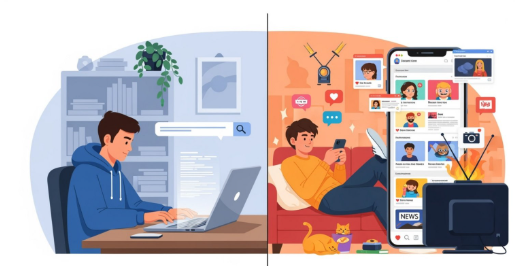
On Google or another search engine, users type a specific question or request. They’re actively searching for a solution, information, or a product. This SEO audience is therefore highly qualified, as they have a real interest in what’s being offered.
On social media, the approach isn’t the same. Users go there mainly out of curiosity or for entertainment. They don’t necessarily want to buy at that moment. Brands distribute their advertising or content in the news feed, which can work, but it’s not as direct as an internet user looking to buy on Google.
Comparing the Customer Journey: SEO vs Social Media
Looking at how a prospect moves to purchase based on the source (SEO or social media) helps understand why SEO converts better.
Level of Purchase Readiness
SEO often reaches people who are already advanced in their purchase project. A person searching for “best online English course” or “SEO audit price Paris” knows what they want. Content well-positioned on these keywords therefore provides an answer and helps the user take the step toward purchase or contact.
On social media, you’ll reach people at all stages: simple curious people, those interested in the brand without wanting to buy, others who will return later. Social media is very good at making a brand known and creating desire, but less effective for immediate purchase decisions.
Conversion Rates by Traffic Source
Because SEO visitors are already actively searching, they convert more often than those from social media. People who arrive via Google already want to solve a problem or make a purchase: they therefore more easily take action (buy, request a quote, etc.). Social media traffic, even when very high, generally converts less well because the desire to buy isn’t always there.
What Concrete Benefits for Clients Thanks to SEO?
In addition to attracting people ready to buy, SEO also provides other advantages for finding clients.
Long-term Visibility and Better Quality Traffic
SEO allows for qualified visitors regularly and over the long term. A well-positioned page on an important keyword can bring useful traffic for months, even years, without spending more money on advertising, while visibility on social media stops quickly if you don’t pay to boost publications.
Visitors coming from SEO are really looking for this type of product or service. They don’t stumble upon the page by chance: they make the effort to search, which greatly increases the chance of selling.
More Trust Thanks to Natural Ranking
Appearing at the top of Google immediately gives a professional and reassuring aspect to a company. Internet users trust well-positioned sites more, which they consider as references. This “validation” aspect by Google helps potential clients trust, even before visiting the site. This trust facilitates the move to purchase.
5 Reasons Why SEO Brings More Clients Than Social Media
| # | SEO Advantage | Explanation |
| 1 | Continuous organic traffic | Unlike social media where a post is only visible for a few hours, a well-referenced page attracts visitors all the time, without depending on current events or algorithm changes. |
| 2 | Targets users in active search | People who come from SEO are really looking for a solution. They’re closer to purchase. |
| 3 | Increases trust through position | A site placed at the top of results inspires confidence, which social media doesn’t do as directly for the purchase phase. |
| 4 | Longer content lifespan | A blog article or SEO page remains visible for a very long time, while a social post quickly disappears in the news feed. |
| 5 | Better prospect tracking | SEO allows better tracking of the user’s journey, from their arrival on the site to conversion, and therefore optimizing each step to win more clients. |
Common Misconceptions About SEO and Social Media
Many people have false ideas about the comparative effectiveness of SEO and social media for finding clients:
Myth: Social Media Replaces SEO
This is false. Social media is essential for certain brands, but it doesn’t replace a good SEO strategy. As explained above, they don’t reach people who are actively looking to buy, and their effect is often shorter.
Myth: SEO is Too Slow and Expensive
It’s true that SEO requires patience, and results don’t happen overnight. However, once visibility is established, SEO often costs less per client than continuously paid advertising. Many businesses choose structured SEO packages to manage this process efficiently, ensuring consistent optimization and measurable growth over time. In the long run, SEO proves to be a profitable investment, especially for attracting prospects who are genuinely ready to buy.
SEO or Social Media: What to Choose for Finding Clients?
It’s not about choosing “one or the other” all the time. Depending on your sector, your target, your budget, and your objectives, you might need a mix of both.
Selecting According to Your Target, Domain, and Means
If you sell services or products that people actively search for, SEO is often the best solution for attracting new clients. If your audience mainly uses social media (young people, visual e-commerce for example), the latter can be a complement, or even the priority.
The most important thing is to think about where your future clients look for their solutions, and concentrate your efforts there.
Using SEO and Social Media Together
The best approach often remains combining both. Social media helps make the brand known, encourages brand searches on Google, which can also help SEO. Sharing articles optimized for SEO on social media brings additional traffic and gives better signals to search engines.
Build a method where SEO attracts people already searching, and social media reinforces brand awareness and the connection with clients. Both are more effective together than separately for attracting maximum clients.
