

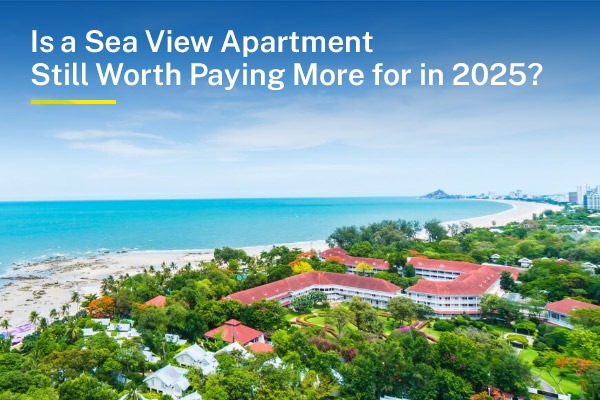
A sea view is one of the few real estate features that defies depreciation. While interior finishes age and technology becomes obsolete, an unobstructed panorama of open water retains its scarcity value indefinitely. For decades, this premium was treated as an emotional variable — priced more by intuition than by data. Today, that approach is shifting. Institutional investors, PropTech platforms, and independent analysts are applying quantitative frameworks to what was once a purely aesthetic consideration.
The acceleration of remote work following the 2020 pandemic permanently redefined what constitutes a productive living environment. Location is no longer just about proximity to an office — it is about quality of life, cognitive ergonomics, and the operational infrastructure that supports full-time remote work. For professionals and investors looking to buy flat in Cyprus, evaluating the premium associated with a Mediterranean panorama is no longer a matter of personal preference, but of calculated rental yields and predictable capital appreciation.
The “Blue Mind” Premium: Quantifying the Coastal Mark-up
Empirical data consistently demonstrates that sea-view apartments command a substantial price premium over comparable units in the same building. Across established Mediterranean markets, historical transaction records show that a full, unobstructed sea view adds between 15% and 40% to the baseline asset value — a range that narrows considerably when precise view classifications are applied.
Industry practice has converged on three distinct categories that meaningfully differentiate pricing. A “full panoramic view” — defined as a horizon-to-horizon water perspective with no structural obstructions — represents the highest-tier premium. “Partial or side views,” where the sea is visible at an angle or partially framed by adjacent buildings, typically generate a moderate mark-up of 8% to 18%. “First-line location,” meaning a property situated directly on the seafront regardless of floor height, commands a combined premium derived from both physical proximity and ambient value — sound, light quality, and microclimate.
The spread between adjacent units on the same floor, where one faces the sea and the other faces inland, frequently exceeds 20% in competitive coastal markets. This intra-building differential makes the view variable one of the most concentrated sources of value in residential real estate — more impactful per square meter than most interior upgrade packages.
PropTech and AI: How Algorithms Price Coastal Proximity
Traditional property valuation relied on comparable sales and the subjective judgment of appraisers who visited sites. That model produced assessments that were accurate at the moment of valuation but poorly equipped to predict how a view — and its associated premium — might evolve over time. Machine learning and satellite imaging have changed this fundamentally.
Modern PropTech platforms construct what the industry calls a “view index”: a quantified score derived from multiple algorithmic inputs. Satellite imagery, processed through computer vision models, enables precise calculation of the visible water percentage from any given window position. Lidar-based 3D city models allow predictive analysis of obstruction risk — identifying parcels of land where future construction could diminish or eliminate an existing view. This analysis is conducted not just for current planning applications, but for all zoned development corridors within a defined radius.
The contrast between human and algorithmic evaluation becomes particularly stark when comparing specific view variables:
| View Variable | Human Evaluation | AI/Algorithmic Evaluation |
| Obstruction Risk | Guesswork based on visible nearby plots | Predictive 3D city modeling across all zoned development corridors |
| View Angle | Subjective assessment during site visit | Exact degree calculation from floor plan coordinates and satellite data |
| Glare & Sunlight | Basic orientation check (north/south/east/west) | Automated thermal impact mapping with seasonal solar trajectory modeling |
The integration of PropTech into coastal property valuation makes the assessment process significantly more transparent and reproducible. Algorithmic evaluation protects investors from two common errors: overpaying for a view that carries structural obstruction risk, and underpricing an asset whose view metrics are stronger than they appear at first inspection.
The Remote Work Surge: IT Professionals Driving Rental Demand
The demographic profile of the sea-view apartment renter has shifted materially since 2020. Seasonal vacationers have been joined — and in many markets overtaken — by a sustained cohort of remote-working professionals, particularly from the technology sector. Software engineers, product architects, data scientists, and engineering managers are now among the primary tenants of premium coastal inventory. Their decision criteria differ sharply from those of the traditional tourist renter.
Four factors explain why technology professionals are consistently willing to pay above-market rates for sea-view units:
- Home Office Ergonomics. Extended screen time creates a clinically documented need for what optometrists call the ’20-20-20 rule’ — focusing on a point at least 20 feet away every 20 minutes. An unrestricted sea horizon provides exactly this visual reset. For engineers working 8–12 hour sessions, this is a functional workspace requirement, not an aesthetic luxury.
- The “Zoom Background” Status Factor. In distributed teams and VC-funded environments, the visual environment behind a professional during video calls carries reputational weight. A Mediterranean panorama communicates a specific message about career success and lifestyle architecture. For founders, senior engineers, and consultants conducting daily calls with international clients, the sea view functions as a visible professional signal.
- Mental Health and Cognitive Performance. Peer-reviewed research in environmental psychology consistently identifies proximity to water as a measurable reducer of cortisol levels and an enhancer of restorative attention. For knowledge workers susceptible to burnout — a recognized occupational hazard in software development — a sea-facing workspace actively supports the cognitive recovery necessary to sustain high-output performance.
- Seamless Infrastructure Requirements. Location preference among IT professionals is infrastructure-conditional. A sea-view apartment without fiber-optic connectivity is disqualified regardless of its visual appeal. Conversely, a coastal unit with enterprise-grade internet, stable power supply, and co-working access nearby commands a significant rental premium — because it converts an attractive location into a fully operational remote work platform.
Architectural Tech: Smart Glass and Energy Efficiency
Panoramic sea-facing glazing creates a thermal management challenge that is particularly acute in Mediterranean climates. Floor-to-ceiling windows oriented toward open water generate substantial solar heat gain during peak summer months, increasing cooling loads and reducing the practical comfort of the space during the hours when the view is most valued.
Electrochromic glass — commonly marketed as smart glass — addresses this conflict directly. Integrated with building management systems, these panels adjust their tint in real time based on solar intensity, interior temperature, and occupant preferences set through a connected application. The result is a reduction in cooling energy consumption of 20–40% compared to conventional glazing, according to lifecycle energy studies conducted on Mediterranean residential projects. For investors, the technology reduces operational costs. For tenants, it eliminates the trade-off between enjoying the view and maintaining a comfortable working temperature — a material factor in the rental calculus of the IT-professional segment.
Calculating the ROI: Is the Premium Worth the Investment?
The financial case for a sea-view apartment depends on four variables that require structured evaluation rather than market intuition. In short-term rental markets driven by platforms like Airbnb, sea-view units in established coastal markets consistently achieve 25–35% higher nightly rates and 15–20% higher occupancy rates compared to non-view inventory in the same building. For long-term rentals oriented toward remote IT professionals, the premium stabilizes at 18–28% above equivalent non-view units.
A systematic approach to calculating view-adjusted returns should include:
- Analyze the micro-market. Review historical rental transaction data specifically for the target building and its immediate comparables — distinguishing between sea-view and non-view units on equivalent floors. Market-level data is insufficient; the analysis must be asset-specific.
- Factor in cooling costs. Model the operational cost of climate control for south- and west-facing sea-view units. In Mediterranean markets, this line item can represent 8–15% of annual rental income in non-smart-glass buildings. Smart glass or advanced shading systems should be included in the investment budget rather than treated as optional upgrades.
- Evaluate short-term vs. long-term rental yields. Short-term seasonal rentals deliver higher peak income but require active management and produce revenue volatility. Long-term leases to IT professionals or corporate tenants generate predictable cash flow with lower vacancy risk — a trade-off that favors the long-term model for investors prioritizing capital preservation over yield maximization.
- Assess future development plans. Cross-reference the property’s view corridor against publicly available cadastral and urban planning registries. Verify that no approved construction projects exist within the visual field that could partially or fully obstruct the sea view. This single step has historically prevented some of the most significant value erosion events in coastal real estate.
Beyond the Horizon: Future-Proofing Your Coastal Asset
Sea views represent one of the few genuinely non-renewable attributes in real estate. Land can be rezoned, buildings can be renovated, neighborhoods can be repositioned — but the water horizon cannot be manufactured or replicated once it is lost to obstructing development. This fundamental scarcity supports a long-term value thesis that is structurally different from most other residential premiums.
The convergence of remote work normalization, IT sector demand, and PropTech-enabled precision pricing is strengthening the investment case for coastal assets rather than diminishing it. As digital infrastructure improves in Mediterranean markets and visa programs continue to attract mobile knowledge workers, the pool of qualified long-term tenants for sea-view inventory will expand further.
The appropriate response to this market dynamic is not speculative acquisition, but data-driven evaluation. Investors who apply algorithmic view assessment, scenario-model obstruction risk, and accurately price operational costs will consistently outperform those relying on market sentiment alone. Before committing capital to a coastal asset, engaging property analytics specialists who combine local market expertise with predictive modeling tools is the most reliable method of converting a premium location into a predictable investment return.
