

It is Thursday afternoon. You just wrapped up a massive, 60-minute industry webinar. Your sales team is immediately pinging you: “Where are the leads? What is the follow-up strategy?”
You stare at the raw Zoom transcript. It is a 10,000-word wall of text, full of awkward pauses, derailed tangents, and inside jokes. To capitalize on the event’s momentum, you need to send hyper-personalized nurture emails to the attendees by tomorrow morning.
But manually reading that massive transcript, extracting the core insights, and writing three different email sequences for different audience segments is a multi-day editorial nightmare. By the time you finish writing and hit “send” on Tuesday, the attendees will have forgotten who you are. The leads will have gone cold.
This is the post-event trap. We spend thousands of dollars driving registration, but we completely fumble the follow-up because we run out of human bandwidth. It is time to stop acting as a manual transcriptionist and start acting as an automated demand-gen architect.
Bypassing the Editorial Bottleneck
The friction of post-event marketing is entirely rooted in synthesis. You are trying to do the work of a copywriter, an editor, and a sales strategist simultaneously, all while the clock is ticking.
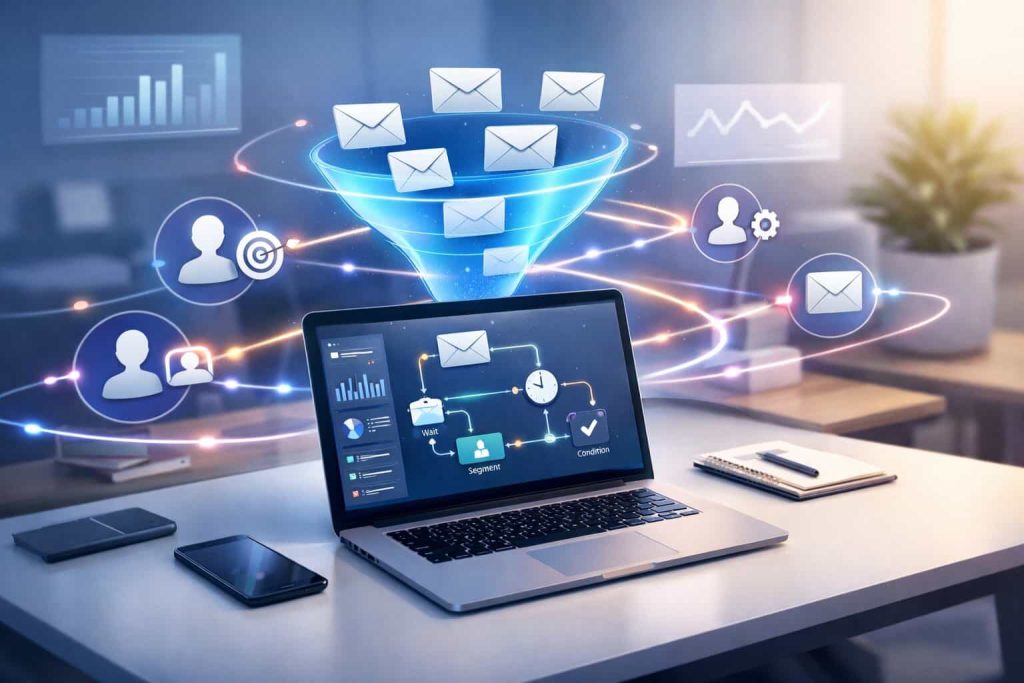
To break this bottleneck, you must decouple the live event from the post-event labor. This is where leaning on SkyClaw Skills fundamentally changes your post-webinar posture. Instead of staring at a blank Google Doc, you use SkyClaw as your asynchronous editorial engine. It isn’t a basic chatbot that you have to actively manage; it is an always-on cloud agent. By combining modular “Skills”—such as long-form document parsing, semantic extraction, and automated copywriting—you simply drop the messy 10,000-word text file into the system, set your parameters, and go grab a coffee.
While you are away from your desk, the cloud agent digests the entire event, identifies the most valuable arguments, and automatically drafts fully segmented, ready-to-send email sequences. Here is how to structure this workflow to turn your raw transcripts into a pipeline acceleration machine.
Strategy 1: Segmenting the “Ghosts” (The Drop-Off Campaign)
Webinar platforms give you brilliant engagement data. You know exactly who dropped off after the first ten minutes.
If you send these people an email saying, “Thanks for attending, here is the full 60-minute recording,” they will delete it immediately. They already decided they didn’t have time for the live event; they certainly aren’t going to watch the replay.
You must isolate the ultimate “FOMO” (Fear of Missing Out) moment.
Set up your asynchronous workflow to hunt for the hook.
- The Prompt: “Analyze the transcript from minute 15 to minute 45. Isolate the single most contrarian, surprising, or counter-intuitive data point our speaker shared. Draft a short, 100-word ‘Sorry you had to leave early’ email. Use that surprising data point as the hook to create curiosity, and link directly to that specific timestamp in the video.”
You are respecting their lack of time while ruthlessly teasing the exact strategic value they missed.
Strategy 2: Mining the Q&A for “High Intent” Leads
The people who stay for the final 10 minutes of a virtual event to listen to the Q&A are your hottest leads. The questions they ask are literal roadmaps to their budget and their anxieties.
But compiling those questions and turning them into sales collateral usually takes days. You can automate this entirely.
Instruct your cloud agent to act as a sales enablement analyst.
- The Prompt: “Isolate the Q&A section of this transcript. Extract the top three technical objections or pain points raised by the audience. Now, draft an aggressive, bottom-of-funnel email for our Account Executives to send to the highly-engaged attendees. Frame the email as: ‘A lot of you asked about [Pain Point X] yesterday. Here is exactly how our software solves that barrier.’ “
You are striking while the iron is hot. You are taking the audience’s exact vocabulary, processing it in the cloud, and handing your sales team a perfectly tailored pitch before the prospect even has a chance to look at a competitor.
Strategy 3: Slicing the 3-Part “Aha!” Drip Campaign
You cannot send one follow-up email and call it a day. A proper nurture sequence requires a multi-touch drip campaign spread over two weeks to keep the brand top-of-mind.
Writing a three-part email series from scratch is exhausting. But a 60-minute transcript has more than enough raw material to fuel a month of content—if you know how to slice it.
Command your cloud agent to act as a content butcher.
- The Prompt: “Read the core presentation transcript. Identify the three distinct ‘Aha!’ moments or strategic paradigm shifts the speaker introduced. Separate them. Now, draft a 3-part educational email drip campaign. Email 1 focuses purely on Insight A. Email 2 focuses on Insight B. Email 3 focuses on Insight C and transitions into a soft pitch for a product demo.”
You have just turned one exhausting live event into an automated, two-week pipeline acceleration engine, without writing a single word from scratch.
Strategy 4: Translating the Altitude (CEO vs. Practitioner)
If your virtual event attracted both Chief Marketing Officers and junior copywriters, sending them the exact same follow-up email is a fatal marketing error.
The junior copywriter wants to know how to execute the tactic. The CMO wants to know how much money the tactic will save the company.
In a manual workflow, writing dual-persona emails takes too long, so marketers default to a boring, generic middle-ground. In an automated cloud workflow, iteration is instantaneous.
Take the drip campaign your agent just generated, and issue a simple remix command:
- “Take the 3-part drip campaign you just generated. Remix it for a C-suite executive. Strip out the tactical software tutorials and ‘how-to’ language. Focus entirely on the macro market trends, the labor cost savings, and the timeline to ROI.”
You are now delivering hyper-relevant, altitude-adjusted nurture tracks. The executives get the business case; the practitioners get the playbook.
Reclaim Your Follow-Up Speed
The ROI of a virtual event is not measured by how many people logged into the Zoom room. It is measured by how quickly and effectively you transition that captured attention into the sales pipeline.
Stop letting your most valuable event transcripts rot in a Google Drive folder just because you don’t have the editorial energy to rewrite them on a Friday afternoon. By delegating the synthesis and segmentation to an always-on cloud agent, you remove the human bottleneck from your demand generation. Let the machine read the messy transcript, extract the brilliance, and write the emails while you sleep. You just focus on closing the deals.
Would you like me to tackle another specific topic from your list, or do you have a new scenario in mind that you’d like to explore?
