

What are Power Testing Solutions?
Power testing solutions refer to specifically designed systems and equipment with methodologies that allows users and engineers to voluntarily configure and control the power and current for evaluating the safety, reliability and compliance electrical and electronic devices connected to the former. The devices being tested are usually those either consume, convert or generator power industries such as automotive, renewable energy, aerospace, telecommunications, and power electronics manufacturing. Power testing solutions typically engage test setups, programmable power sources, loads, and measurement instruments that simulate real-world electrical conditions (AC or DC) to validate how a device behaves under different voltage, current, and environmental scenarios.
Power testing solutions are as well key approaches that certificating and inspection companies rely on and resort to to validate the products their client send over to them for acquiring certificates for regulatory compliance in their industry.
What are Battery Simulators for Power Testing Solutions?
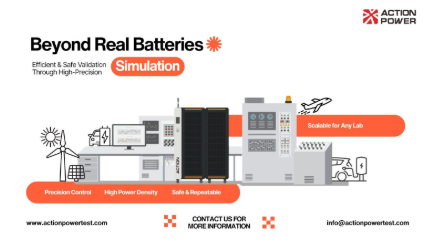
Battery Simulators are specialized programmable power sources designed to emulate the electrical behavior of real batteries during testing. In the context of Power Testing Solutions, they replace physical batteries to provide a safe, controllable, and repeatable test environment for devices that charge from or discharge into batteries, such as EV chargers, battery management systems (BMS), DC/DC converters, and energy storage systems (ESS).
A battery simulator behaves like a real battery by controlling its voltage, current, and internal resistance according to a predefined charge/discharge profile or dynamic conditions. It can source or sink power, meaning:
- Source mode: acts like a discharging battery (supplying current to the DUT).
- Sink mode: acts like a charging battery (absorbing current from the DUT).
Top 6 Battery Simulator Manufactures in the World
Battery simulator manufacturers are typically advanced power-electronics companies specializing in programmable bidirectional power supplies, regenerative loads, and grid simulation systems. They often originate from the test and measurement or ATE industry, serving sectors such as electric vehicles, aerospace, and energy storage that demand precise and repeatable battery behavior emulation.
These firms are highly R&D-driven, standards-compliant, and offer modular, scalable designs that can simulate cells, modules, or full packs. Their products integrate real-time digital control, software interfaces, and automation capabilities, backed by strong engineering support, safety certifications, and global service networks bridging real-world electrochemical performance with laboratory precision for development and validation.
Regatron AG (Switzerland)
Regatron is a Swiss-based specialist in high-power programmable DC supplies and battery simulation/emulation systems. The advantage of their battery simulators is in very high dynamics, real-time battery modelling (electro-chemical & electrical behaviour), scalable up to high voltages/large packs (even MW level), and full bidirectional operation (source & sink) for R&D, production or grid/energy-storage test benches
Key technical metrics of Regatron AG Battery Simulators:
- G5.BAS series offers power range from ~9 kW up to 5,000 kW+; voltage range from ~60 V up to 3,000 V DC.
- They also claim control dynamics in the 100–200 µs range, high stability and accuracy (voltage accuracy <0.01–0.02% FS, current accuracy ~0.03–0.09% FS) for module/pack testing.
ActionPower
ActionPower is a Chinese power-electronics company founded in 1996 and headquartered in Xi’an, Shaanxi Province. It designs and manufactures programmable power supplies, electronic loads, automated test equipment (ATE), and test systems for industries such as electric vehicles (EVs), energy storage systems (ESS), photovoltaics (PV), power conversion and industrial verification. The firm emphasizes high-precision, modular, bidirectional power systems and regenerative capabilities, positioning itself as a “global manufacturer” of power-testing solutions.
Advantages of ActionPower Battery Simulators
- Bidirectional operation & regeneration: ActionPower’s battery simulators can both source and sink power (charge and discharge emulation). For example, the TITAN series supports regenerative feedback to the grid with up to ~94% efficiency.
- High voltage/power scalability: the products support very high DC voltages (up to ~2000 V) and large power levels (up to multi-megawatt scale via parallel operation) enabling simulation of full packs or ESS rather than just cells or modules.
- Dynamic response & modelling capability: built-in support for battery chemistry emulation (LFP, NMC, LTO, lead-acid, etc.), internal resistance modelling, 1st/2nd/3rd-order RC equivalent circuits, and fast command update rates (1 ms) for realistic transient behaviour.
- Modular and parallel-expandable architectures: units can be paralleled/stacked to reach high power outputs; this modularity supports flexible configuration according to test bench needs.
Key Technical Metrics & Specifications of ActionPower Battery Simulators
- Output voltage range: 12 V to 2000 V DC.
- Power output: from ±300 kW up to models rated ±1000 kW (for example ABS-E100-2014: ±1000 kW, voltage 20-2000 V, current ±1400 A) in a single cabinet.
- Voltage slew rate: up to 200 V/ms.
- Load rise/fall times: e.g., ≤2 ms rise time (10%-90%), ≤4 ms switching time between −90% to +90%.
- Voltage / current accuracy: ±0.1% of full scale (F.S.) for both voltage and current.
- Regenerative energy feedback: capability of ~94% regeneration efficiency to grid when emulating discharging.
- Model support: supports built-in chemistry profiles (LiMn₂O₄, LCO, LFP, NiMH, etc.), configurable series/parallel cell count, internal resistance, custom RC models, CSV import of custom battery models.
- Parallel operation: units can be connected in series/parallel to achieve up to ~10 MW output in large configurations
Keysight Technologies
Keysight Technologies is a long-established leader in test & measurement instruments, and their battery emulator/ profiler solution is aimed primarily at device-level and lower-power battery emulation (for IoT, portable devices, etc.). The advantage of this product is that it allows engineers to emulate various battery charge states, perform fast run-down tests, compare current drains, and avoid the variability of actual physical batteries.
Key technical specifications include:
- Maximum power: 200 W, maximum voltage: 30 V, maximum current: 20 A, number of channels:
- Its high accuracy programming and read-back (e.g., voltage programming accuracy ~0.025% + 1.5 mV) are also notable
AMETEK Programmable Power
AMETEK Programmable Power offers DC power systems designed for battery simulation (among other things). The advantage: modular, bidirectional, regenerative architectures capable of emulating battery behaviour for high-power applications (automotive, aerospace, industrial). They support a range of voltages/currents and allow parallel/series connection for scaling.
Key technical specs:
- the Mi-BEAM series: voltage 600 to 2,000 V, current 5 to 150 A, power 12 to 37 kW;
- the i-BEAM series: voltage up to 1,000 V, current up to ±1,000 A, single-system power up to 650 kW, parallel up to 1.3 MW.
Chroma ATE Inc.
Chroma is a Taiwanese company specialising in automated test equipment (ATE) for batteries, EVs and related systems. Their battery simulator solutions excel in multi-channel, higher-power, and pack-level simulation. The advantages include multichannel pack state simulation, regenerative discharge (saving energy), rapid switching between charge/discharge, and support for many channels in parallel, which is very helpful for large current demands.

Key technical metrics of Chroma Battery Simulators
- For the 17020/17040 series: e.g. model 17020 offers power per channel of 600 W, 1.25 kW, 2.5 kW, 5 kW, 10 kW, 20 kW, 30 kW, 50 kW, 60 kW, with voltage modules of 20V, 60V, 100V, 200V, 500V; up to 2,600 A maximum current when paralleled.
- The 17040 series scales much higher (up to approx. 600 kW per channel, voltage to 1,000 V, current up to ~1,500 A when paralleled).
ITECH Electronic Co., Ltd.
ITECH (China) is another manufacturer that offers battery simulation / power test equipment, catering to cost-sensitive applications or regional markets. The advantage: offering competitive pricing, decent technical capability, and suitability for applications where high-volume or cost-efficient battery simulation is required (for example in module/pack testing in mass manufacturing).
Key metrics: ITECH offers programmable sources/loads with voltage/current ranges tailored for battery emulation, though exact publicly-posted “mega-pack” specs are less visible in the sources I found.
Wrap-Up
Battery simulators are critical tools for testing EV chargers, BMS, and energy storage systems under realistic and repeatable electrical conditions. The global landscape of battery simulator manufacturers is shaped by a handful of technologically advanced companies that combine precision power electronics, digital control, and regenerative design.
Leading international players are typically test and measurement specialists with decades of experience in programmable power systems. They offer simulators with wide voltage ranges (often up to 2000 V), high accuracy, and ultra-fast dynamic response. Most adopt bidirectional architectures with regenerative energy feedback to improve efficiency and sustainability in high-power testing.
European and American manufacturers are known for software-defined control, automotive-standard compliance, and robust integration into ATE platforms, while Asian firms lead in scalability, cost-effectiveness, and modular power design.
Among them, ActionPower stands out as a fast-growing innovator from China, offering high-performance, modular, and regenerative battery simulators that rival leading global brands. Its TITAN and ABS series deliver up to ±2000 VDC and multi-megawatt output with millisecond-level response, chemistry modeling, and energy recovery efficiency above 94%.
Together, these manufacturers form the technological backbone of modern EV, ESS, and power electronics testing, driving the transition toward electrification with precision, efficiency, and safety.
