

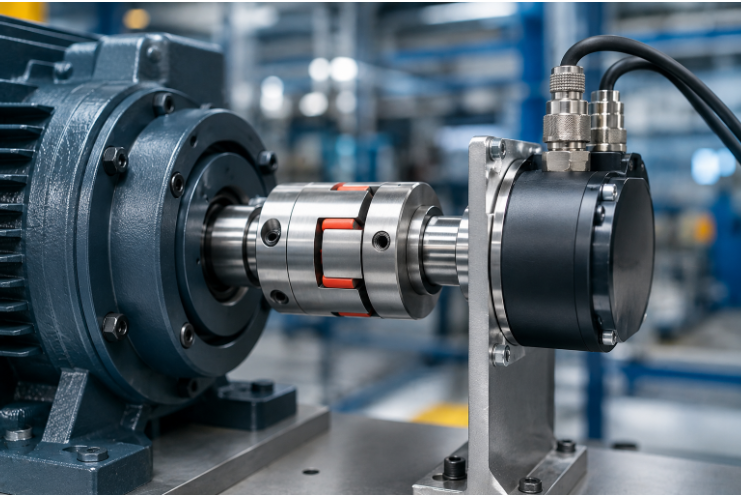
Australian industries use industrial interchange couplings and absolute angle encoder technology in large, heavy-duty equipment to improve their motion accuracy, reliability, maintenance efficiency, and operational outcomes in highly demanding environments.
Key Takeaways
- Industrial interchange couplings will help you maintain reliable encoder connections despite shaft misalignment and vibration.
- Absolute angle encoders provide precise shaft-position information for large machinery in demanding environments.
- Industries combine mechanical protection with accurate feedback to improve equipment reliability and control.
- These technologies are particularly valuable across mining, ports, steel, and bulk material handling.
- Correct component selection is important to reduce maintenance interruptions and support longer equipment service life.
Heavy industrial equipment must always maintain accurate movement and reliable feedback while operating under vibration, shock, temperature changes, and continuous loads. Robust coupling technology and precise absolute position feedback help to improve machine performance and operational efficiency.
Why Do Industrial Machines Need Reliable Encoder Connections?
Rotary encoders convert mechanical movement into electronic signals used by control systems to determine position, speed, and direction. An absolute angle encoder provides a defined position value for the shaft’s angular position. This is particularly valuable where machinery requires accurate and repeatable positioning.
However, the encoder itself is only part of the system. Sometimes, shaft misalignment, vibration, and electrical interference place additional stress on encoder assemblies. You can use a suitable coupling to compensate for certain alignment errors, which will protect the encoder and connected machinery. As a result, Industrial interchange couplings can contribute to:
- Reliable torque and motion transmission.
- Compensation for specified axial, parallel, or angular misalignment.
- Reduced mechanical stress on encoder shafts.
- Isolation from damaging bearing or shaft currents where an isolated design is used.
- Longer encoder service life.
For example, depending on the model you use, certain double-joint coupling designs compensate for parallel misalignment of up to ±1 mm and axial misalignment of up to ±2 mm.
How Does Absolute Angle Encoder Technology Improve Machine Control?
An absolute angle encoder will provide you with precise shaft-position feedback, helping industrial control systems monitor and manage rotating equipment accurately. This can improve operational consistency in demanding applications where positioning, speed, and reliability matter. Key benefits of the absolute encoder include:
- Accurate positioning: You have access to reliable information about shaft position for precise machine control.
- Continuous monitoring: Supports continuous monitoring of rotational movement and equipment performance.
- Reduced mechanical stress: When paired with a suitable coupling, it will help you accommodate specified shaft movement and misalignment.
- Harsh-environment performance: Heavy-duty encoder designs can withstand demanding industrial conditions, including vibration and shock.
- Improved efficiency: You get accurate feedback to reduce positioning errors and support smoother automated operations.
- Maintenance support: You can access reliable position data that can help you identify abnormal equipment behaviour and potential issues earlier.
These benefits make the absolute angle encoder technology valuable across mining, ports, crane systems, steel processing and bulk material handling.
Where Can These Technologies Improve Operational Efficiency?
| Industry | How the Technologies Are Used | Operational Efficiency Benefit |
| Mining | Couplings support reliable encoder connections, while absolute encoders provide shaft-position and rotational feedback on heavy machinery. | Supports dependable equipment control, reduces mechanical stress, and helps identify performance issues earlier. |
| Ports & Crane Systems | Absolute encoders monitor the position and movement of cranes, while couplings help maintain accurate mechanical connections. | Improves positioning accuracy and supports safer, more consistent material-handling operations. |
| Steel & Rolling Mills | Encoder systems provide continuous speed and position feedback in demanding production environments, with couplings helping manage shaft movement. | Supports process consistency, reliable motion control, and reduced encoder-related maintenance interruptions. |
| Bulk Material Handling | Encoders monitor conveyor and drive-system movement, while couplings help transmit motion reliably between connected shafts. | Enables consistent equipment operation and helps reduce unexpected downtime caused by connection or feedback issues. |
| Industrial Automation | Absolute position feedback allows control systems to monitor rotating machinery accurately, while flexible couplings accommodate specified alignment conditions. | Improves motion accuracy, automated control, and overall equipment reliability. |
Table: Industrial applications of coupling and absolute encoder technology
Together, these technologies help industrial operators maintain accurate motion feedback, reduce mechanical stress, and support more reliable equipment performance, even in the most demanding operating environments.
How Should You Select the Right Coupling and Encoder?
The operational efficiency of your industrial equipment will depend on matching the components to the machine rather than selecting equipment based only on general specifications. When you’re choosing coupling and encoder technology, you must consider multiple factors, including:
- Shaft alignment: Determine the expected angular, axial, and parallel misalignment.
- Operating speed: Check whether the coupling and encoder can safely operate at the required rotational speed.
- Load and torque: Match the coupling to the machine’s torque and transmission requirements.
- Environment: Consider vibration, shock, temperature, dust and moisture exposure.
- Shaft configuration: Confirm bore dimensions, keyways and mounting requirements.
- Electrical isolation: Consider isolated coupling designs where shaft or bearing currents may be a concern.
- Feedback requirements: Choose absolute encoder technology when accurate position information is critical to machine control.
Most importantly, you must ensure that the coupling and encoder are mechanically and technically compatible with your specific industrial application. This will help you prevent compatibility problems and unnecessary maintenance issues.
Final Verdict: Combine Mechanical Reliability With Precise Feedback
Industrial interchange couplings and absolute angle encoder technology address two key aspects of any heavy machinery performance: reliable mechanical connection and accurate motion feedback. When you use them appropriately, you can ensure better control, reduce component stress, and contribute to longer service life, even when operating in the demanding Australian industrial environments.
Need More Reliable Motion Control for Heavy Equipment?
Consult a top industrial equipment expert right now to assess your shaft alignment, operating environment, and feedback requirements and identify the ideal coupling and absolute encoder technology suited to your industrial application.
