

The best furnace on a quote sheet is regularly the wrong furnace for the house it is going into. That argument lands badly in a mid-1990s Lenexa subdivision where four neighbors with the same floor plan were quoted the same jump from 80 percent to 96 percent efficiency in one season, and where the furnace companies lenexa ks homeowners call are working from the same product lineup. The rating is real and the newer equipment genuinely is better built. What that rating earns back, though, is settled by one house’s gas use and by what its venting costs to change. Ranking the tiers takes a minute; proving the top tier pays for itself in a specific 1,900 square foot two-story is the work that keeps getting skipped.
Efficiency Tiers Climbed Faster Than Paybacks
Two decades ago an 80 percent furnace was the standard install and a 90 percent unit was the upgrade nobody insisted on. Today the 80 percent unit is the thing being argued out of the basement, and condensing equipment in the mid-nineties range gets presented as the only responsible choice. Manufacturing caught up fast. The savings side did not, because what a higher tier can hand back is capped by how much gas the house burns in the first place.
The tiers climbed. The paybacks stayed roughly where they were.
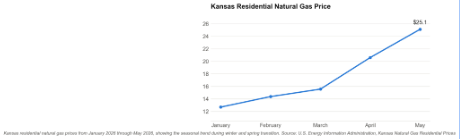
Fuel price is the other half of that arithmetic, and it moves on its own schedule. The chart above tracks what Kansas households actually paid per thousand cubic feet across a recent heating season and into spring, and the spread inside a single year is wider than most homeowners assume when they picture their savings. A payback figure built on last winter’s price is an estimate, not a promise.
Run it for one house on that street. Say it burns roughly 700 therms a winter and the season’s gas bill lands near 900 dollars. Moving from 80 to 96 percent does not shave 16 percent off that bill, because it only recovers the share currently going up the flue, which in a house this size sits closer to 140 dollars a year.
Now set that against the installed price gap, which commonly runs 1,800 to 2,800 dollars between the two tiers before anybody touches the chimney. That is a payback measured in more than a decade, on equipment nobody guarantees will still be running when the decade is up. The tier worth buying is the one your own gas bill pays for, not the one the neighbors were quoted. For a drafty house with a much larger fuel appetite the answer flips completely, which is precisely why it has to be modeled instead of assumed.
One House Decides The Answer Not The Trend
Two identical floor plans can land on opposite answers, and the reason usually sits behind the furnace rather than inside it. A condensing unit vents through PVC out a sidewall and needs a condensate drain, so the masonry chimney it used to share with the gas water heater gets abandoned. Leave that water heater by itself on an oversized flue and its exhaust can cool, condense, and stop drafting the way it should. Job after job, that one detail swung the final number more than the efficiency tier did, because on some houses it means a liner and on others it means nothing at all.
Safety is not a footnote in that conversation. Any appliance still sharing a flue needs a combustion and draft check after a change like this, and a cracked heat exchanger on an aging furnace is worth ruling out during the same visit. If a carbon monoxide alarm sounds, get everyone out of the house and call 911 from outside.
The rule I handed people was short enough to remember. If the sidewall termination is a straight shot and the house burns a lot of gas, the condensing furnace usually wins. If the venting has to be rerouted or the chimney lined, and the fuel bill is modest, the 80 percent replacement wins on money and nothing else about the house changes.
One thing I could never pin down was resale. Nobody I know tracks whether a 96 percent furnace changes what a 1990s two-story sells for around here, and I have never once seen it broken out on an appraisal. Buyers notice a new furnace. Whether they pay extra for the efficiency badge on it is a question I still cannot answer, so I never let a payback argument rest on it.
Ask For The Payback Before The Model Number
Ask for the number before the model number. A quote worth taking seriously shows this house’s estimated fuel use at each efficiency level with the installed price sitting beside it, and it spells out what venting work each option triggers. A company that cannot produce that is selling a catalog rather than a heating system. A free estimate that includes a real load calculation and a look at the flue beats a discount on the wrong equipment every time.
Age belongs in that same conversation, because it changes the question being asked. A January 2026 breakdown of how long furnaces actually last from Wyckoff Comfort puts a unit at 19 years or older at or near the end of its expected service life, and treats it as replacement territory rather than repair territory. A furnace in its nineteenth winter that still heats the house fine is not proof of anything; it is a unit running on a schedule nobody published.
So the honest advice is duller than the sales pitch. Get two numbers for your own address, at two efficiency tiers, with the venting priced into each one. Most of the furnace companies Lenexa KS homeowners call will do that if they are asked directly, and the ones who model it before naming a tier are the ones worth a second call. Sometimes the answer really is the 96 percent unit. It just needs to be the answer your house gave, not the answer the street is repeating.
