

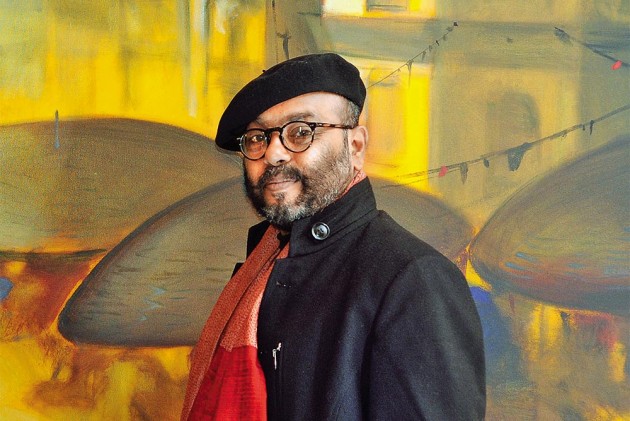
Indian landscapes have long inspired artists – yet only a handful have captured their spirit with the force and feeling that Paresh Maity brings. He paints the tight alleys of Banaras, the wide Rajasthan deserts plus the quiet Kerala backwaters. Bright colour broad brush-marks and a clear pulse of motion run through each piece. The land appears to breathe, to sing, to murmur its tales from every canvas.
Paresh Maity is praised not only for his skill with colour but for turning the feeling of Indian places into pictures that surround the viewer. His trips through every part of India support the slow change of his art – they place him among local customs shifting daylight, brief meetings between people and the quiet verse that lives in everyday sights. That bond between the soil and its people lifts him away from most artists who work this day.
A Life Shaped by Travel and Observation
The artistic journey of Paresh Maity has been inseparable from his constant travels. He was born in Tamluk, West Bengal, where dawn breaks through thin fog, rivers run wide, fields stay green and the sky shifts colour hour by hour. After those first years, he carried that sight with him and painted it across the country. Each town he visited taught him a new lesson – each person he met gave him another word for his visual language.
When he draws the warm gold of a Rajasthan sunset or shows the steady line of boats on the Ganges, Maity sees land and sky as places that hold feeling. He states that he puts down on paper what he feels, not only what his eyes report – that shift from sight to emotion gives the work its singular life.
He starts – making fast sketches and watercolours on the spot. Those loose studies let him take in the place – the heat, the noises, the way light bounces. Back in the studio he blows those memories up into big canvases packed with colour, abstraction plus brute force.
The Power of Color and Scale
Maity’s most obvious trademark is his fearless colour. For him colour is feeling, not method. His reds give off heat, his blues settle the eye, his yellows shine like sun on rough plaster. The strong hues say more than what the land looks like – they tell what the mind feels.
His landscapes often leave the line between realism and abstraction unclear. Shapes of ghats boats, deserts or streets appear – yet they sit inside a dreamlike world where colour rules over form. Each painting feels familiar and new right away. Viewers recognize the place yet step into a deeper, meditative experience.
Scale also serves as a vital part of his storytelling. Maity has produced some of the largest paintings in India – some works extend for multiple meters. The sheer size of the canvases surrounds viewers plus gives the sense that they stand inside the landscape itself. Those monumental works affirm his belief that landscapes are not small windows for passive viewing – they are vast worlds that invite entry.
Rajasthan: A Land of Endless Inspiration
Rajasthan has shaped Maity more than any other place. The hot colours of the desert, the sharp lines of its buildings and the busy markets return again plus again in his paintings. He does not show the desert as it looks in a photograph – he shows how it feels – the heat that rises from the sand, the quiet of the villages and the life of the culture that bursts out in strong colours but also patterns.
In the Rajasthan set of works he lets warm surfaces speak – scorched orange, sand yellow, dark red. Those colours give the viewer the size and force of the desert. Maity refuses to present Rajasthan as empty – he underlines its pulse as well as life and gives back its lyrical appeal.
Banaras: The Eternal Muse
Another subject that returns in his landscapes is the holy city of Banaras. Maity shows the ghats, boats, rituals and the daily bustle along the Ganges. Many artists paint Banaras with quiet colours or a hush of holiness – Maity shows it as a bright, restless place.
He paints long horizontal lines that repeat the river’s drift, broken colour blocks that show the stacked steps of the ghats plus soft shapes for people to show that life and prayer never stop. In his view Banaras is a place where time pauses yet still moves, where stories, feelings but also customs live side by side in rare balance.
Kerala and the Serenity of Water
Kerala shapes Maity’s art through flowing forms, mirrored planes and cool colours. In those works he paints boats, lagoons plus still water with pale blues and greens. The pictures uncover a quiet, inward, almost song like part of the man. Where the Rajasthan set blaze but also shout, the Kerala set breathe and whisper. The difference shows how Maity tunes both mood and method to the spirit of each place.
Watercolours: A Medium of Freedom
Maity uses oil acrylic, sculpture and mixed media – yet his watercolour stands out. Hardly any present day artist controls that runny, unruly pigment as he does.
His watercolours spring to life without plan – they follow feeling alone plus carry raw emotion.
- Quick observation
- Precision in brushwork
- Harmony between colour and light
- A poetic approach to composition
Many art critics have said that his watercolour landscapes feel like memories captured in motion—fleeting but full of life.
Why Paresh Maity’s Landscapes Connect Globally
Maity’s landscapes appeal to everyone because they speak plainly to the feelings. When he paints scenes that belong to India, the picture still crosses borders. People from other lands need not name the place – they still sense the air, the beat and the mood.
His landscapes combine:
- Indian cultural depth
- Modern visual interpretation
- Emotional storytelling
- Powerful colour techniques
- Grand scale and fluidity
This mixture gives his art worldwide appeal – he speaks for India on international stages and shows viewers the many faces of the country’s visual culture.
Conclusion
Paresh Maity paints Indian scenes that carry strong feeling. Each canvas shows a personal trip through the country’s centre. He turns colour local life and recollection into pictures that strike the viewer – that skill has brought him notice in India plus overseas. With bright colour, lively brush-marks and a firm sense of site, he keeps shifting the way the public sees the land.
To look through groupings of works chosen with artists like Paresh Maity in mind and to find outstanding contemporary pieces, go to ArtAliveGallery.
