

Table of Contents
- Introduction
- What Is RAID 10?
- Key Benefits of RAID 10
- Implementing RAID 10 in Modern Systems
- Real-World Applications of RAID 10
- Conclusion
Introduction
Reliable and high-performance data storage is a foundational requirement for today’s businesses, regardless of size or industry. The ability to access, store, and recover information efficiently often determines the success and resilience of organizations in the digital age. As data volumes grow exponentially and application demands intensify, organizations face increasing pressure to prioritize storage solutions that deliver speed and fault tolerance. RAID 10 is one of the best configurations to address these challenges. Its unique blend of mirroring and striping technologies optimizes performance and resiliency from the ground up, empowering businesses to support mission-critical applications and achieve seamless continuity even during hardware failures.
The robust architecture of RAID 10 supports demanding workloads. It provides immediate protection against hardware failures, making it an ideal choice for organizations where downtime or data loss can incur significant costs. Lengthy interruptions or unrecoverable losses can be disastrous in sectors like finance, healthcare, and e-commerce, where even brief outages may result in monetary penalties, reputational damage, or compromised security. This article will guide you through the core principles behind RAID 10, explore its key benefits, and describe its implementation and practical applications in modern data environments, illustrating why RAID 10 remains the preferred choice for industries where reliability and speed are paramount.
What Is RAID 10?
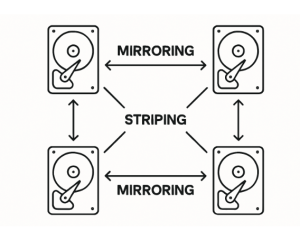
RAID 10, also called RAID 1+0, is an advanced disk configuration that merges two foundational RAID levels: RAID 1 (mirroring) and RAID 0 (striping). This means data is first mirrored across pairs of drives to create duplicate sets, and then these mirrored sets are striped to distribute data evenly across all disks in the array. By combining both strategies, RAID 10 ensures every piece of data is not only duplicated for protection but also efficiently organized for optimal access speed. Each write and read operation benefits from being spread across multiple disks. At the same time, redundancy ensures that a single drive failure does not cause data loss or halt access to critical information.
Unlike more basic RAID setups, RAID 10 requires a minimum of four drives but offers faster recovery and higher reliability. When compared to traditional RAID configurations, RAID 10 eliminates the bottleneck of having only one set of mirrored drives or only a single striped array, instead providing a synergistic approach that improves both efficiency and security. Organizations with critical data or high transaction volumes frequently turn to RAID 10 for its near-instantaneous failover capabilities and efficient workload distribution compared to other RAID topologies. This is particularly important for high-volume environments such as online transaction processing (OLTP), enterprise databases, virtualization, and cloud servers, where interruptions or lag times can have large-scale effects.
Key Benefits of RAID 10
Superior Performance
RAID 10’s data striping mechanism allows operations to be executed in parallel across multiple drives, effectively multiplying the speed at which the system can process read and write requests. This parallelism significantly improves read and write speeds over basic RAID 1 or RAID 5 configurations, making RAID 10 a top choice for performance-driven workloads such as database servers, virtualization environments, and applications with heavy input/output requirements. The increased throughput translates to faster application response times, streamlined data processing, and more efficient handling of simultaneous requests. As a result, businesses that rely on real-time analytics, quick data recovery, or high-volume transactions see tangible improvements in their day-to-day operations and strategic outcomes.
Robust Redundancy and Data Protection
The mirroring aspect of RAID 10 means every piece of data is copied in real time to a second physical drive. If one drive fails, a replica exists on its pair, ensuring data integrity without interruption. Unlike parity-based RAID schemes, RAID 10 does not rely on recalculating lost information through parity data, which can be slower and more resource-intensive. This level of protection is invaluable for organizations requiring always-on services or those handling sensitive information, such as financial data or patient records. With real-time duplication, businesses are shielded from the prospect of catastrophic data loss, even during peak usage times or unforeseen incidents. RAID 10’s inherent design makes it more resilient to multiple drive failures than single mirror setups or striping alone, provided that no mirror pair loses both disks simultaneously.
Streamlined Recovery
When a drive fails in a RAID 10 array, data is instantly accessible from the mirrored partner, and the rebuild process is efficient, causing minimal performance degradation. Unlike parity-based arrays (such as RAID 5 or RAID 6), there is almost no vulnerability window, which reduces downtime and business risks. The absence of parity calculations during recovery also means less strain on remaining drives, permitting quicker restoration of full redundancy and protection. This can mean the difference between seamless continued operation and costly downtime in mission-critical settings. The efficient rebuild process translates into ongoing stability. It minimizes the risk of a second failure occurring before the array is healed, a weakness typically seen in some parity-based configurations.
Implementing RAID 10 in Modern Systems
As storage technologies have evolved, integrating RAID 10 has become more seamless and cost-effective. Today’s IT professionals can leverage various sophisticated tools to implement RAID 10 in both small business and enterprise-scale environments. Advanced software-defined solutions now make it simpler to configure RAID 10 with traditional HDDs or cutting-edge NVMe SSDs, offering flexibility and scalability to meet evolving computing needs. Hardware advancements such as the Adaptec SmartRAID 4300 series further streamline this process, supporting up to 32 NVMe SSDs and delivering exceptional read speeds ideal for high-throughput scenarios. For additional context on how these hardware solutions are shaping enterprise performance, consider reading Tom’s Hardware’s analysis of the SmartRAID 4300.
Choosing the right RAID hardware controller or trusted software-defined management interface is critical. It ensures consistency in configuration, monitoring, and maintenance, and quicker identification and replacement of failed drives within an array. Deployment can involve on-premises servers, virtualized platforms, or hybrid cloud environments, depending on the organization’s needs and growth trajectory. Regardless of infrastructure, regular monitoring, proactive maintenance, and periodic testing of redundancy protocols are essential for long-term reliability.
Real-World Applications of RAID 10
RAID 10 configurations are indispensable in industries where data availability and throughput are non-negotiable. Financial institutions, healthcare providers, research organizations, and cloud service platforms leverage RAID 10 solutions to support mission-critical databases, transaction logging, and real-time analytics. These environments often demand the speed to process thousands of transactions per second and the resilience to guarantee zero data loss. For instance, every second of downtime in banking can result in denied transactions and a loss of customer trust. At the same time, hospitals require instant access to patient records for proper care delivery.
Innovative collaborations are further expanding RAID 10’s potential. For instance, the partnership between storage giants Kioxia and Xinnor has led to enterprise-ready RAID solutions optimized for next-generation PCIe 5.0 NVMe SSD infrastructures. This aligns RAID 10 with the future of datacenter performance—a topic explored in detail in Medianet’s coverage of the Kioxia-Xinnor collaboration. These technology partnerships help accelerate data movement and enhance processing speeds, ensuring businesses remain competitive and agile as their data and infrastructure requirements evolve.
Conclusion
RAID 10 continues to offer a balanced and scalable approach to enterprise storage, merging the best attributes of performance-focused and redundant RAID configurations. As businesses modernize their infrastructure to manage ever-growing volumes of data, RAID 10 remains a vital solution for ensuring uninterrupted operations, superior performance, and peace of mind. Organizations adopting RAID 10 are better prepared to withstand hardware failures, scale their operations, and deliver seamless customer experiences. Adopting RAID 10, especially in tandem with state-of-the-art hardware controllers and SSD technology, is a forward-thinking strategy for any organization striving to secure and accelerate its data operations while positioning itself for the future of digital business.
