

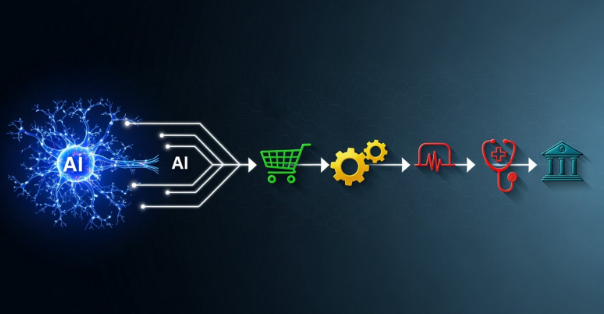
Artificial Intelligence (AI) is now a practical tool that is actively changing how businesses work in 2025. AI is automating routine work, creating customized customer experiences, and helping companies get much more done. AI is moving quickly from research labs into everyday work life.
Now, the main question for companies is not whether AI will change their industry but how fast they can adjust and use these tools to compete. Companies that don’t use AI today could be left behind soon. To get the best results with AI, many businesses are working with professional SEO services to maximize the reach and impact of their AI projects.
AI’s footprint on society and business has never been so large. Studies like Stanford’s 2025 AI Index Report confirm its major influence. This report gathers and presents unbiased facts about AI for policymakers, researchers, journalists, executives, and the public. It helps everyone see how quickly AI is growing and what changes to expect.
Understanding Artificial Intelligence in Business
In business, Artificial Intelligence means using computers and algorithms to solve business tasks, automate work, and make smarter decisions. AI helps machines do things that previously required human intelligence, like learning, solving problems, and understanding language. This is helping companies become more efficient, lower costs, and make more money.
AI development services include creating AI models, software, and automation tools built around specific business goals. Top organizations are using these to base decisions on data, improve day-to-day processes, and gain competitive advantages.
What Are Machine Learning and Deep Learning?
Machine learning (ML) and deep learning are some of the main forces behind today’s AI changes. Machine learning teaches computers to learn from data and find patterns, rather than following strict instructions.
The more data an ML model works with, the better it gets. Businesses use ML for tasks like predicting what customers will do, finding bank fraud, or suggesting products on shopping sites.
Deep learning is a part of machine learning that uses artificial neural networks, inspired by the human brain, to tackle bigger and tougher problems.
Deep learning is very good at understanding images, processing text, and making predictions. It’s widely used for voice recognition, analyzing customer feelings, and finding issues in medical images. For instance, healthcare AI can spot problems in scans or predict patient declines.
What Is Generative AI?
Generative AI is a recent and popular kind of machine learning. Unlike models that only spot patterns and make predictions, generative AI creates new things-like text, images, audio, or video-based on the data it has studied. Examples include language models like Google’s Gemini, Microsoft’s Copilot, and Meta’s Llama, which can understand questions, write emails, and come up with ideas.
Generative AI is shifting from being experimental to a core part of business, driving productivity and stronger customer connections. Its ability to create useful content quickly is why companies now see it as one of the most powerful technologies around.
For example, in 2024, 64% of senior data leaders viewed generative AI as potentially the most important tech of this generation. It’s being used not just for automating customer service and updating back-office work, but also for more creative processes like customizing marketing.
How Is AI Different from Traditional Automation?
AI and traditional automation both help make work faster and easier, but they are not the same. Traditional automation runs on fixed rules-machines or software do the same tasks again and again, in exactly the same way. This works well for simple, routine jobs, like putting together products in a factory or moving data from one place to another.
AI, meanwhile, can learn, figure things out, and make choices by looking at data. It can handle tasks where the rules aren’t always clear, adapt if things change, and even come up with new solutions.
An AI-powered customer service bot, for example, can understand and answer many types of questions because it learns from real conversations. That flexibility and ability to learn set AI apart from traditional automation, making it a strong tool for all kinds of jobs.
Main Trends in AI for Business in 2025
By 2025, the world of AI is moving quickly, with trends that are changing how companies use and think about technology. The rapid spread of new ideas, increased use of AI, and new debates about ethics are pushing businesses to pay attention to AI’s role in today’s economy.
AI in Day-to-Day Operations
AI is now part of everyday business and not just experiments. For example, the number of FDA-approved AI medical devices rose from 6 in 2015 to 223 in 2023. Self-driving cars now operate on real city streets-Waymo gives more than 150,000 rides each week in the US, and Baidu’s robotaxis are running in many Chinese cities.
From customer service automation to software development and supply chain management, AI is now a core part of business operations. Companies are focusing less on “having an AI strategy” and more on using AI to improve their most important work-like using AI agents in retail for better customer service, marketing, and online sales.
AI Is Becoming Easier and Cheaper
The costs to use AI are dropping fast. In a short time, running systems like GPT-3.5 has become more than 280 times less expensive. AI hardware is about 30% cheaper each year, and more energy efficient, too.
At the same time, “open weight” models (free or low-cost versions of powerful AI) are helping smaller companies use tools that used to be out of their price range. This opens up opportunities not just for large firms, but for small and medium businesses as well.
The simple interface of most generative AI tools means even people without deep AI skills, such as regular software engineers, can use and benefit from these systems. This helps companies bring tools like auto transcription or self-help chatbots into their business more quickly.
AI Investment and Use Are Growing Fast
Spending and adoption of AI is reaching new highs. In 2024, private AI investment in the U.S. hit $109.1 billion. Global spending on generative AI jumped almost 19% from 2023 to $33.9 billion. AI isn’t just getting more money, it’s also being used by more companies-78% of organizations now use AI, compared to 55% the year before.
| Industry | AI Adoption Rate (2024) | Common Applications |
| Finance | 57% | Data analysis, predictive modeling, fraud detection |
| SaaS | 76% | Process improvement, automation |
| All businesses (general) | 65% use AI to cut manual/repetitive work | Automation, workflow optimization |
SaaS, banking, and retail are especially active in putting AI to use, and more businesses join in every year.
AI Models Keep Getting Better
AI is quickly improving on complex tests and tasks. New standards like MMMU, GPQA, and SWE-bench allow researchers to measure how smart these systems are, and scores are rising fast. AI models can now make high-quality videos or solve programming challenges sometimes better than people can, especially under time pressure.
The U.S. leads in top AI models, but China is catching up quickly, and model performance is more even worldwide. Big technology improvements in the speed and scale of AI training make new ideas possible every few months.
Using AI Responsibly: Best Practices and Issues
As AI becomes a bigger part of business, being responsible about how it is used is more important than ever. Reports are showing more incidents caused by AI errors or misuse, and there aren’t many standard tests for safety yet. While companies are slow to put checks in place, new tools for measuring how accurate or safe AI models are are starting to help.
Governments, on the other hand, are moving faster on policies. In 2024, groups like the OECD, EU, UN, and African Union shared new guidelines to encourage transparency and safety. More oversight from governments, along with public demand for safe and ethical AI, is making businesses set up clear policies for things like “deepfake” detection and risk management.
Industry Examples: Where AI Is Making a Difference
AI’s benefits can be seen in almost every major industry. The examples below show how AI is being used for real-world improvements and new opportunities.
Healthcare: Better Diagnoses and Treatment
Healthcare is changing fast because of AI. Medical imaging AI tools are helping spot problems on scans with great accuracy, while predictive analytics can warn about high-risk patients sooner. The FDA’s approval of hundreds of AI devices in medicine shows how seriously the industry is adopting AI.
AI is also pushing personalized health care. By looking at huge amounts of information-from records to DNA-AI can help doctors give treatments suited to each person. AI-powered chatbots can answer patient questions and set up appointments automatically, while longer-term, AI will help with things like drug discovery.
Finance: Fraud Prevention and Automated Support
The finance industry, always data-heavy, is using AI to find fraud in real time and reduce losses. Quick, smart search tools now answer customer questions or flag risky events sooner than in the past. AI is saving banks time and money, but keeping up with regulations and protecting privacy are still big concerns.
Moreover, these technologies are not only improving security but also shaping how customers experience banking services. In this regard, a strong focus on CX in Banking typically ensures that automated tools deliver faster, more accurate, and more personalized support, helping banks maintain trust while improving customer satisfaction.
Retail and E-Commerce: Personalizing the Shopping Experience
AI is a game changer for online stores and retail chains. It powers product suggestions based on what shoppers bought or browsed, predicts demand, manages stock, and sets better prices.
Retailers use generative AI to answer service questions, create custom marketing, and even design product descriptions on the fly. Nordstrom, for example, uses AI to help shoppers find the right items and keep stores stocked with popular products.
Manufacturing and Supply Chain: Predictive Maintenance
Manufacturers use AI to reduce errors, improve quality, and keep machines running. Predictive maintenance tools find signs that equipment might break and alert teams before costly failures. Rockwell Automation’s AI system is a good example: it predicts problems and recommends repairs ahead of time.
AI is also helping manage supplies and production steps, cutting waste and speeding up deliveries. Over half of companies in these sectors use or plan to use AI soon.
Media and Entertainment: Content Creation and Personalization
Media companies are using AI to create content, customize viewer experiences, and analyze what audiences like. Generative AI helps write scripts, create subtitles, and even suggest new show ideas. These tools are making it easier to create and share media across the world, and in the future, AI could shape entire production workflows, supporting creative teams-not replacing them.
Pros and Cons of Adopting AI
Using AI has huge potential, but also some challenges. Being aware of both is important for companies who want to use AI well.
Benefits: Better Productivity and Higher Profits
- Staff with AI tools are 80% more productive.
- Customer service reps handle nearly 14% more inquiries per hour.
- Business users write 59% more documents; programmers finish 126% more code tasks per week.
- Overall work output with AI tools is up by 66% compared to before-what would have taken decades of improvement before, now happens in one year.
- A Harvard study showed management consultants using AI completed work 25% faster and produced higher quality results.
Most leaders who invest in AI say it pays off, with some companies seeing big jumps in revenue thanks to AI-driven improvements. Goldman Sachs predicts AI could boost the global economy by $7 trillion over the next ten years.
AI Boosts Customer Service
Businesses are using AI-powered chatbots and language tools to deliver quick, personalized help, improving customer happiness and sales. AI systems spot patterns in what customers like and suggest the right products, leading to higher satisfaction and better marketing. Companies have seen up to 20% higher customer satisfaction and 10-15% more sales using these tools.
For example, Brinks Home improved appointment scheduling and product recommendations with AI, growing its revenue by almost 10% and nearly doubling the average order size. More businesses plan to use AI for customer-facing tools-and customers support this, with a large majority wanting AI-powered self-service options.
Risks: Bias, Opacity, and Security
Even with many benefits, using AI comes with risks. AI models can absorb biases from their training data, leading to unfair decisions. Most companies don’t properly deal with bias, and over half of employees worry that AI tools give wrong or biased answers. The “black box” nature of some AI models means it’s often hard to know why an AI made a certain decision.
Security is a big issue, too. Sophisticated tools can be misused, such as in deepfakes. Organizations must set up strong AI defenses and control what data goes into models to avoid data breaches and leaks. Developing clear policies and using private models can help.
Employee Impact: Shifting Jobs, Not Just Replacing Them
AI will change jobs-some will disappear, like back-office paperwork, but others will appear. The World Economic Forum expects companies to cut about 41% of some roles by 2030, especially admin and legal jobs, but also create new ones, expecting 170 million fresh roles worldwide. The fastest growth is for jobs like AI and data specialists.
Rather than simply replacing people, AI is more likely to change what workers do, calling for new skills. However, there’s a gap-most employers and staff aren’t sure which AI skills to learn, highlighting the need for more training and upskilling.
How to Build AI Into Your Business
Bringing in AI isn’t about throwing tech at every problem: the best results come from picking the right uses and tools for your company’s real needs. For businesses looking for tailored solutions, custom ai development services can design, build, and integrate AI tools specifically for your operations, ensuring maximum efficiency, personalized customer experiences, and measurable business value.
- Directly supports business goals
- Has clear value and measurable improvements
- Fixes real pain points or opens new opportunities
- Moves past small pilots and delivers scalable results
A good approach is to use a decision table or matrix to score different ideas based on the value they could bring and how realistic they are to implement.
Choosing Between Machine Learning and Generative AI
Which tool should you use? If the goal is to create content (text, images, video), generative AI is likely best. If you’re working with sensitive business data or need narrow expertise (like medical diagnoses), traditional machine learning is usually better.
For example, banks with proven fraud detection ML systems often stick with those for sensitive jobs, only adding generative AI when trying brand-new ideas. Use generative AI for new, creative tasks; use ML where security and precision matter most.
Mixing AI Types for Best Results
The ideal solutions often use both ML and generative AI. For example, a traditional ML model could predict health trends, while a generative AI tool adds personal information for deeper insights.
Generative AI also helps speed up the ML model-building process by cleaning data or creating examples. However, it’s important to keep checking the outputs, since mistakes can add up if both systems get things wrong.
AI Rules, Ethics, and Compliance in 2025
As AI spreads, keeping use ethical and legal is becoming a top concern. New policies and guidelines from governments and organizations are appearing all over the globe.
Current Rules and Regional Gaps
- More U.S. rules on AI-59 regulations announced in 2024; global mentions of AI in legislation have grown rapidly.
- OECD, EU, UN, and African Union have rolled out common principles, especially for transparency and safety.
- There are still big differences between how regions feel about AI-in some countries people are excited, in others more skeptical, which could mean different rates and kinds of AI regulation.
- Governments are also investing a lot-Canada and China are putting billions into AI research and industry.
Tips for Ethical and Clear AI Use
- Draft clear guidelines about how AI is used.
- Tackle bias and test models for fairness.
- Use new standards for checking safety, like HELM Safety and AIR-Bench.
- Consider hiring specialists to focus on AI rules and ethics.
- Use explainable AI practices so staff and customers know why AI makes certain decisions.
The public expects to know when they are speaking with AI and wants human review for important automated outputs.
Staying Ready for New Rules
Because AI rules are changing quickly, companies should keep up with new laws, test out how future rules could affect them, and build compliance from the start of AI projects. Engaging with regulators and industry groups can help companies prepare and even influence how the rules are shaped in the future.
The Road Ahead: AI’s Future in Business
Artificial Intelligence will keep reshaping companies and industries in ways we’re just starting to see. Integration will go even deeper, changing every aspect of work, decision making, and global business competition.
What’s Next for AI? New Tech and Smarter Agents
- Advances in multimodal AI will allow one system to combine skills with text, images, and audio.
- Expect retail to get smarter, with AI advisors that know the customer and the products across all platforms.
- Healthcare AI will start to simulate body processes for better treatment.
- Finance AI will expand not only into cost-saving areas but also customize and create brand-new types of financial services.
- Combining AI with tech like IoT means more intelligent decisions and real-time automation without always needing cloud servers.
AI’s Part in Sustainable Growth
AI can help companies streamline how they use resources, cut waste, and make greener choices. For example, predictive AI in factories can stop breakdowns-saving energy and materials.
AI-managed supply chains can reduce shipping emissions and product spoilage. It’s also expected to add a huge boost to the world economy, mainly by driving efficiencies and creating new industries.
Preparing Workers for an AI Economy
As AI changes the workplace, demand will increase for skills that work alongside technology-like creative thinking, problem-solving, and teamwork. By 2030, AI could mean a net gain of 78 million jobs, focusing on AI expertise and roles that mix human and machine skills.
Businesses and schools should offer training so workers learn how to use AI or shift into new roles, as these skills are becoming much more valuable. Long-term business success will depend on staff who can keep learning and use AI tools to their full potential.
