

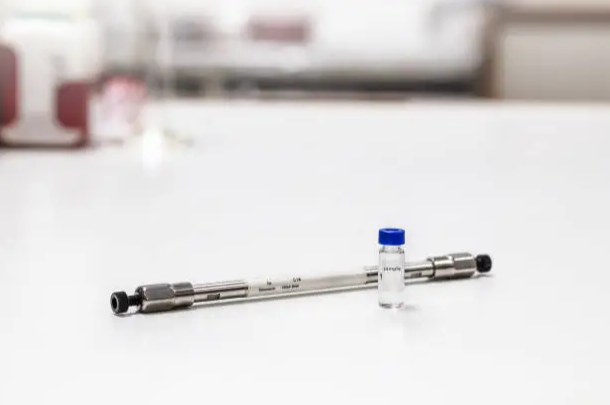
💡 Grasp the essentials of C18 Columns in Chromatography! Unveil their applications and benefits for enhanced lab results.🧪🔬👩🔬
Chromatography
Chromatography is a fundamental separation technique used to isolate and analyze components within a mixture. It relies on differences in the affinities of compounds for stationary and mobile phases, allowing distinct separation of chemical substances. This method plays a vital role across various scientific fields, including chemistry, biology, pharmaceuticals, and environmental analysis, facilitating the purification, identification, and quantification of substances in diverse samples.
Columns in Chromatography
Columns are critical components in chromatography, as they house the stationary phase and determine the efficiency and selectivity of separation. Their design directly influences resolution, retention times, and overall analytical performance. Understanding the Types of C18 Reversed Phase Columns and Application Purposes helps researchers select the most suitable column for their specific analytical needs. Selecting the appropriate column ensures accurate and reproducible results, which are essential for research, quality control, and regulatory compliance in chemical analysis and laboratory settings.
C18 Columns
C18 columns, also known as octadecylsilane or reverse-phase columns, are integral tools in high-performance liquid chromatography (HPLC). These columns feature stationary phases composed of 18-carbon alkyl chains attached to silica particles, forming a hydrophobic surface that enables the separation of a wide range of compounds based on polarity.
The versatility of C18 columns makes them highly sought after across multiple disciplines, including pharmaceuticals, environmental analysis, food testing, and biochemistry. They efficiently separate complex mixtures, such as metabolites, peptides, proteins, and small organic molecules. Modern C18 columns are designed for high resolution, selectivity, and reproducibility under varying chromatographic conditions. Understanding their structure and function is essential for researchers aiming to optimize separation methods, improve sample resolution, and enhance sensitivity in analytical measurements.
C18 columns are a type of reverse-phase chromatography column that utilizes octadecylsilane as the stationary phase. These columns separate compounds primarily based on hydrophobic interactions, making them ideal for analyzing nonpolar and moderately polar substances. Their widespread application reflects their reliability and versatility in both biological and chemical research.
The Structure and Characteristics of C18 Columns
Structurally, C18 columns consist of aliphatic hydrocarbon chains bonded to silica surfaces. Their non-polar characteristics provide excellent separation of hydrophobic compounds, resulting in high stability, reproducibility, and efficient retention. This design ensures improved resolution, sharper peaks, and consistent retention times, which are essential for analytical accuracy in HPLC experiments.
Working Principle of C18 Columns in Chromatography
C18 columns operate on the principle of hydrophobic interaction. Non-polar compounds interact strongly with the hydrophobic stationary phase, leading to prolonged retention, while polar molecules elute more quickly. This differential interaction enables precise separation of analytes within complex mixtures, allowing accurate identification and quantification of target compounds.
Function of C18 Columns in the Chromatography Process
C18 columns provide a non-polar stationary phase that enhances the retention of hydrophobic molecules, improving the resolution of complex mixtures. This capability is particularly valuable in pharmaceuticals, environmental testing, and food analysis, where precise separation of analytes is critical for accurate results.
How C18 Columns Aid in Sample Separation
By leveraging hydrophobic interactions, C18 columns retain organic compounds selectively, allowing differential elution based on polarity. This process results in clear separation of components within mixtures, improving analytical accuracy and reproducibility. C18 columns enable researchers to isolate specific compounds efficiently, which is vital for both qualitative and quantitative analysis.

Unique Aspects That Set C18 Columns Apart from Other Column Types
C18 columns are distinguished by their hydrophobic surface, which ensures strong retention of non-polar compounds. Their octadecylsilica phase provides high resolution, sensitivity, and robustness, making them suitable for diverse applications. Unlike other stationary phases, C18 columns combine versatility with reliability, offering consistent performance across various analytical challenges.
Use of C18 Columns in the Pharmaceutical Industry
In pharmaceuticals, C18 columns are widely used to separate complex mixtures during HPLC analysis. They efficiently retain hydrophobic active pharmaceutical ingredients, facilitating accurate quantification and purification. Their precision supports quality control, regulatory compliance, and method development, ensuring drug safety and efficacy.
Role of C18 Columns in Environmental Analysis
C18 columns are critical in environmental testing, where they separate and identify organic pollutants. Their hydrophobic characteristics enable the retention of diverse contaminants, allowing accurate measurement of water, soil, and air samples. By improving detection and quantification, C18 columns support environmental monitoring and policy compliance.
Application of C18 Columns in the Food Industry
In the food industry, C18 columns are used to analyze flavors, nutrients, and potential contaminants. They provide accurate separation of complex mixtures, supporting quality control and ensuring food safety. Their efficiency enhances analytical reliability, making them indispensable in modern food laboratories.
Other Industries Where C18 Columns Are Used
Beyond pharmaceuticals, environmental testing, and food analysis, C18 columns are employed in cosmetic testing, biochemical research, and industrial chemistry. Their versatility allows them to adapt to various applications, reflecting their broad utility across scientific disciplines.
Enhanced Sample Separation and Resolution
C18 columns improve separation and resolution by creating distinct retention differences between compounds. This results in clearer identification and more precise quantification of analytes, which is crucial for scientific research and quality control.
Improved Detection Sensitivity
C18 columns enhance detection sensitivity, allowing even minimal concentrations of compounds to be accurately measured. This is particularly important in environmental monitoring, pharmaceutical testing, and clinical analysis, where trace-level detection is often required.
Versatility and Compatibility
C18 columns are compatible with a wide range of HPLC systems and analytical methods. Their adaptability allows seamless integration into various workflows, making them a flexible choice for laboratories with diverse analytical needs.
Longevity and Durability
These columns are known for their durability, maintaining performance under high pressures and repeated use. Their robust construction ensures long-term reliability, minimizing downtime and reducing operational costs for laboratories.
Other Unique Benefits
Additional advantages include consistent reproducibility, high chemical stability, and the ability to handle complex matrices. These qualities make C18 columns an indispensable tool for laboratories aiming for high precision and reliability.
Recent Advancements and Innovations
Recent developments in C18 column design include optimized surface chemistry, improved pore structures, and refined particle sizes. These enhancements increase separation efficiency, resolution, and speed, enabling laboratories to handle increasingly complex samples with higher accuracy.
Trends Influencing the Future of C18 Columns
Emerging trends include miniaturization for high-throughput applications, the use of greener solvents, automation, and integration with advanced data analytics. These innovations are expected to improve reproducibility, efficiency, and sustainability in chromatographic workflows, ensuring C18 columns remain at the forefront of analytical chemistry.
C18 columns remain foundational tools in chromatography due to their hydrophobic properties, versatility, and reliability. They provide high-resolution separation, improved sensitivity, and consistent performance across diverse industries. By understanding their structure, applications, and benefits, researchers and laboratories can optimize analytical outcomes and maintain high standards of precision in their work.
